Blog


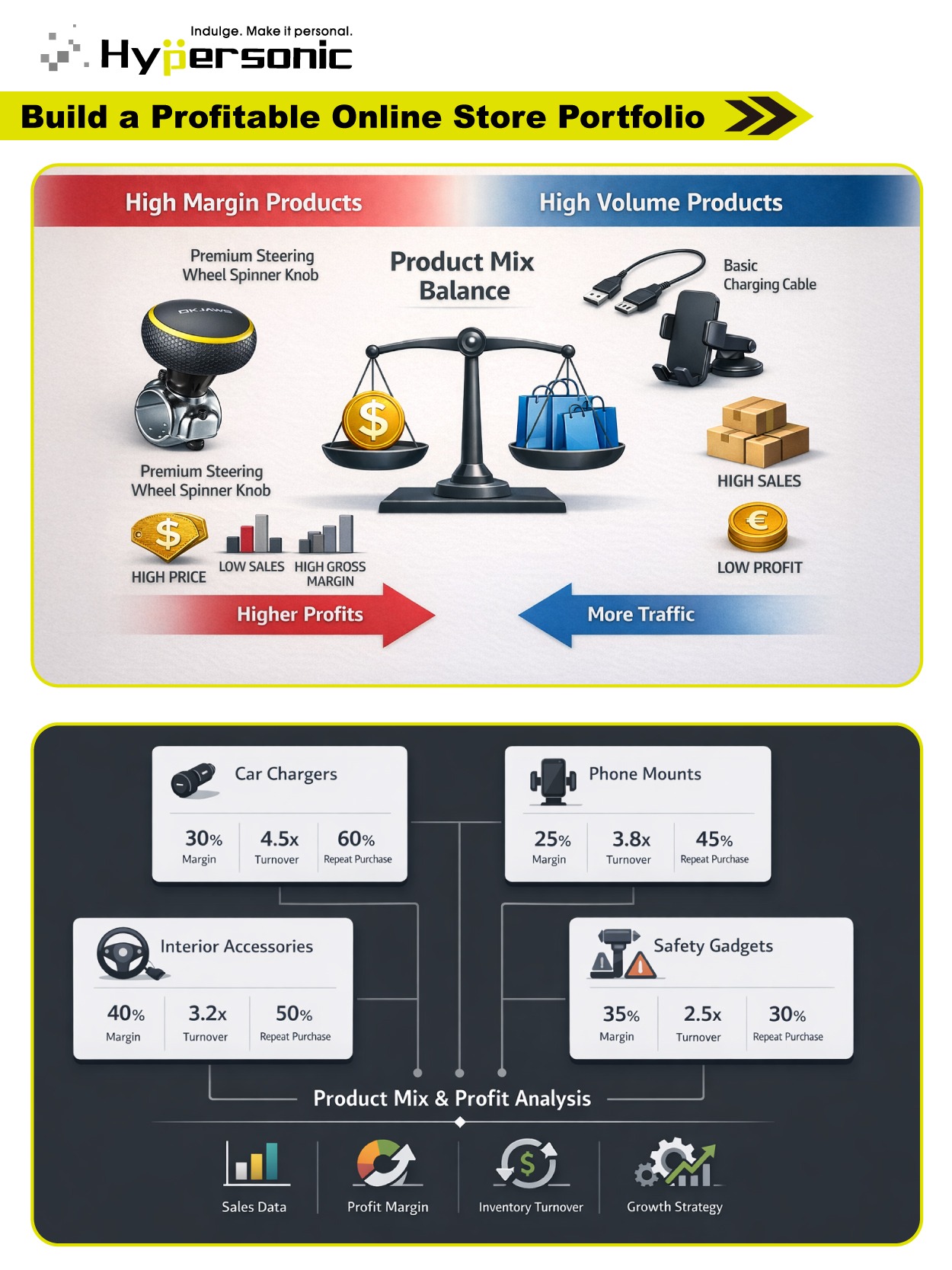
In e-commerce, product mix strategy refers to how you intentionally structure your catalog—what products you sell, how many variations you offer, and how each SKU contributes to revenue and margin. Rather than listing as many items as possible, a strong product mix strategy defines clear roles for every product: some attract traffic, some drive volume, and others deliver profit. As a result, assortment becomes a growth lever instead of a maintenance burden.
However, car gadgets are especially margin-sensitive. On one hand, competition is intense and price comparison is easy, which compresses margins quickly. On the other hand, demand is often volume-driven, meaning many stores rely on high sales numbers to compensate for thin profits. Therefore, without a deliberate mix of high-margin SKUs and stable sellers, stores can appear busy while remaining unprofitable.
Moreover, many online retailers misunderstand where profitability actually comes from. Although traffic and ads receive most of the attention, consultants often see that assortment design is the real bottleneck. In practice, most stores fail because they:
As a result, even growing stores struggle to scale profitably. By contrast, retailers who treat car gadget assortment as a strategic system—balancing margin, demand stability, and operational efficiency—build businesses that grow with control, not chaos.
Summary:
This section shows that profitability in car gadgets is not driven primarily by traffic or promotions, but by a deliberate product mix strategy. By understanding the margin-sensitive, volume-driven nature of car gadgets and avoiding common assortment mistakes, online stores can design a catalog that supports sustainable growth, stable demand, and healthier profits.
To build a profitable car gadget assortment, you must first understand who is buying and why they are buying. Although car gadgets may look similar on the surface, buyer intent varies significantly across customer types. As a result, the same SKU can perform very differently depending on who you are targeting.
Most successful online stores serve a mix of three core buyer personas. However, each group behaves differently and values different benefits.
Daily drivers are the largest segment. They typically look for convenience, safety, and ease of use. For example, phone mounts, charging accessories, or visibility-enhancing gadgets appeal strongly to them. Because these buyers are price-aware, margins can be thinner. However, demand is stable and repeat purchases are common.
Commercial and fleet users, on the other hand, buy with practicality in mind. They prioritize durability, compliance, and long-term value. Although order volume per transaction is often higher, the buying cycle is longer. Therefore, SKUs targeting this group must emphasize reliability and consistency rather than novelty.
Enthusiasts and DIY modifiers behave very differently. They are more emotionally driven and often willing to pay higher prices. As a result, this segment supports higher-margin SKUs. However, demand can be less predictable and more trend-sensitive.
Buyer intent directly determines which products convert and which sit idle. For instance, shoppers with a clear replacement need tend to convert quickly. In contrast, curiosity-driven buyers may browse extensively but purchase less often.
Because of this, mixing SKUs without considering intent creates imbalance. Although a store may carry many products, only a small portion truly supports profitability. Therefore, aligning SKUs with specific buyer motivations is essential for an effective product mix strategy.
Impulse car gadgets rely on emotional triggers such as novelty, aesthetics, or perceived convenience. They perform well during promotions but are harder to forecast. Replacement products, however, solve an immediate problem. As a result, they convert more reliably but often face stronger price competition.
Successful stores balance both. While impulse products lift average order value, replacement products stabilize revenue. Ignoring this distinction often leads to over-investment in low-conversion SKUs that look attractive but fail to scale.
Summary:
This section highlights how understanding buyer personas and buying intent shapes smarter car gadget assortment decisions. By recognizing the differences between daily drivers, fleet buyers, and enthusiasts—and by balancing impulse and replacement products—online stores can avoid low-conversion SKUs and build a product mix that supports both stable demand and long-term profitability.
A profitable car gadget portfolio is never accidental. Instead, it is built on a clear assortment framework that defines why each SKU exists and how it contributes to business goals. Although many stores add products reactively, consultants approach assortment as a structured system. As a result, every product earns its place.
The core assortment includes products with consistent demand and predictable performance. These SKUs sell year-round and form the backbone of revenue. Because they are operationally stable, they support forecasting, replenishment, and long-term planning.
By contrast, the extended assortment exists to test opportunities and capture incremental demand. These products may be seasonal, trend-driven, or niche-focused. Although they can boost short-term revenue, they should be carefully controlled. Otherwise, they increase complexity without improving profitability.
Therefore, winning stores clearly separate core products from experimental ones, rather than treating every SKU equally.
Within the assortment, not all products play the same role. Hero products are highly visible, frequently promoted, and often used in ads or landing pages. Although they may not always have the highest margins, they attract attention and build momentum.
Supporting SKUs, however, exist to complement hero products. They improve average order value, reduce decision friction, or complete a solution. As a result, their value is measured not only by standalone sales, but also by how they enhance overall basket profitability.
Retail and e-commerce consultants often classify car gadgets into three functional layers:
By structuring the catalog this way, each SKU has a defined job. Consequently, assortment decisions become strategic rather than emotional.
Summary:
This section introduces a practical framework for building a winning car gadget assortment. By separating core and extended assortments, distinguishing hero products from supporting SKUs, and applying the traffic–margin–trust model, retailers can ensure every SKU contributes clearly to traffic, conversion, or long-term profitability.
High-margin SKUs are the backbone of a profitable car gadget portfolio. However, margin alone is not enough. Instead, successful retailers evaluate margin together with demand stability, return risk, and operational complexity. As a result, high-margin SKUs become sustainable profit drivers rather than short-lived wins.
In car gadgets, a high-margin SKU is not simply one with a high markup. Rather, it combines several characteristics:
For example, products that solve a specific problem or enhance convenience often justify higher pricing. Therefore, differentiation—whether through design, packaging, or positioning—plays a critical role in protecting margins.
Certain car gadget categories consistently support healthier margins. Accessories and add-ons, such as mounts, organizers, or enhancement tools, often have lower production costs while maintaining strong perceived value. Similarly, compliance-light products—those not subject to heavy certification or regulatory complexity—reduce both cost and risk.
However, although these categories look attractive, scaling them blindly can backfire. Without proper validation, higher margins may be offset by higher return rates or customer dissatisfaction.
Many stores focus on margin percentage while overlooking manufacturing stability. This is a costly mistake. Even a high-margin SKU becomes unprofitable if quality inconsistency leads to returns, negative reviews, or supply disruptions.
Therefore, consultants emphasize repeatability and supplier reliability. Stable materials, consistent tolerances, and predictable lead times protect margin over time. In contrast, unstable manufacturing introduces hidden costs that silently erode profitability.
Scaling should always be gradual. First, validate conversion rates and return behavior at small volumes. Then, increase exposure only when performance remains stable. As a result, growth happens without damaging brand trust.
Summary:
This section explains that high-margin SKUs in car gadgets must be evaluated beyond markup alone. By focusing on perceived value, selecting the right product categories, and prioritizing manufacturing stability, retailers can scale profitable SKUs responsibly—without increasing return rates, operational strain, or brand risk.
One of the most common challenges in building a profitable car gadget assortment is deciding how many categories to offer versus how many variations to carry within each category. Although expanding the catalog can feel like growth, it often introduces hidden costs. Therefore, successful stores treat breadth and depth as strategic levers, not expansion goals.
Expanding product breadth—adding new categories—makes sense when you can address a distinct customer need without overlapping existing SKUs. For example, adding a new functional category can unlock cross-selling opportunities and increase average order value. However, category expansion should only happen when sourcing, content, and support capabilities are already stable.
In contrast, expanding product depth—adding variants such as sizes, finishes, or mounting options—works best when demand is already proven. Because variants share supply chains and marketing assets, they often scale more efficiently. As a result, depth usually delivers higher ROI than unchecked category expansion.
SKU overload is a silent profitability killer. Although more choices seem customer-friendly, too many similar options increase:
Consequently, conversion rates drop while operational complexity rises. Many consultants observe that stores with excessive SKU counts spend more time managing products than selling them. Therefore, restraint is often more profitable than expansion.
While there is no universal number, consultants often apply a simple guideline:
In practice, every SKU should justify its existence through margin contribution or strategic value. If it does neither, it should be reconsidered.
Summary:
This section clarifies how balancing assortment breadth and depth directly impacts profitability. By expanding categories only when strategic and prioritizing depth where demand is proven, retailers can avoid SKU overload, reduce operational strain, and maintain a product mix that scales efficiently and profitably.
Pricing and bundling are where a car gadget assortment turns from “selling products” into engineering profitability. Although many stores focus only on unit price, consultants know that margin optimization happens at the portfolio level, not the SKU level. Therefore, smart pricing structures and bundles can increase revenue without triggering price wars.
Car gadgets are highly influenced by perceived value. As a result, psychological pricing plays a major role in conversion. For example, prices that sit just below common thresholds often outperform round numbers, even when the difference is minimal. Moreover, framing matters: positioning a product as a “daily driving essential” justifies a higher price than presenting it as a generic accessory.
However, psychological pricing should never erode margin discipline. Instead, it should be used to support SKUs that already have healthy contribution margins. Otherwise, stores risk boosting volume while weakening profitability.
Bundling is one of the most effective ways to increase average order value (AOV) while protecting margins. Rather than discounting individual products, consultants recommend solution-based bundles that feel valuable to the buyer.
Common high-performing bundle types include:
Because bundles combine multiple SKUs, they shift the buyer’s focus from unit price to overall value. As a result, price sensitivity decreases.
The key advantage of bundling is margin control. Although bundles often include a small perceived discount, the overall margin remains strong because:
Therefore, bundling improves both revenue efficiency and operational performance. When executed correctly, it transforms an average car gadget assortment into a scalable, high-margin revenue system.
Summary:
This section demonstrates how strategic pricing and bundling unlock hidden profitability in car gadget assortments. By applying psychological pricing and designing value-driven bundles—such as starter kits, safety bundles, and upgrades—retailers can increase AOV, reduce price sensitivity, and optimize margins without sacrificing brand strength or operational control.
Inventory risk is one of the fastest ways profitability leaks out of an online car gadget business. Although sales may look healthy on the surface, excess stock, poor timing, or supplier constraints can quietly drain cash flow. Therefore, effective inventory risk management must happen before products scale, not after problems appear.
Not all underperforming SKUs are the same. Slow movers are products with consistently weak sell-through, regardless of promotion or season. They often signal poor product–market fit or excessive competition. In contrast, seasonal winners sell aggressively during specific periods but remain dormant the rest of the year.
Because of this difference, consultants treat them differently. Slow movers should be identified early and removed quickly. Seasonal products, however, require precise forecasting and controlled replenishment. Otherwise, what looks like a strong seller can easily turn into dead stock once demand drops.
Minimum Order Quantities (MOQs) are a common but underestimated risk. Although suppliers may offer attractive unit pricing at higher volumes, large MOQs increase exposure. As a result, stores often lock up capital in unproven SKUs just to access lower costs.
Supplier dependency compounds this risk. When a single supplier controls lead times, tooling, or quality, even minor disruptions can halt sales. Therefore, margin calculations must include supply flexibility, not just landed cost. A slightly lower margin with better control often outperforms a high-margin SKU with fragile sourcing.
Experienced consultants rarely scale new SKUs immediately. Instead, they recommend phased SKU testing:
This approach protects cash flow and creates data-backed confidence. Although growth may appear slower, profitability is far more stable. Over time, disciplined testing prevents inventory from becoming a liability.
Summary:
This section emphasizes that inventory risk management is essential to protecting profitability in car gadgets. By distinguishing slow movers from seasonal products, avoiding MOQ and supplier dependency traps, and applying phased SKU testing, retailers can control inventory risk before it damages cash flow or limits growth.
Profitability in car gadgets is not a one-time setup—it is an ongoing optimization process. Although intuition and experience are useful, they are not enough at scale. Therefore, high-performing online stores rely on SKU-level data to guide every assortment decision. As a result, product mix strategy becomes measurable, repeatable, and far less risky.
Not all metrics deserve equal attention. Consultants typically focus on a small set of indicators that directly reflect assortment health:
Individually, these metrics tell partial stories. However, when viewed together, they clearly reveal which SKUs strengthen profitability and which quietly erode it.
Consultants do not look at dashboards to admire growth—they look for imbalance. For example, a SKU with strong sales but declining margin may indicate rising costs or over-discounting. Conversely, a low-volume SKU with excellent margin and attach rate may deserve more visibility.
Moreover, trends matter more than snapshots. A gradual increase in return rate, although easy to ignore, often signals quality or expectation issues. Therefore, consultants prioritize directional signals over short-term spikes.
Data-driven assortment management ultimately leads to three decisions:
By making these decisions regularly, stores avoid emotional attachment to products. Instead, the product mix evolves based on evidence, not assumptions.
Summary:
This section explains how continuous profitability improvement depends on data, not instinct. By focusing on key metrics such as SKU-level margin, attach rate, and return rate—and by interpreting dashboards the way consultants do—retailers can confidently decide which car gadgets to kill, keep, or scale, refining their product mix strategy over time for sustainable growth.
Even experienced online sellers fall into predictable traps when building a car gadget assortment. Although these mistakes often look harmless in the short term, they quietly undermine margins and long-term scalability. Therefore, understanding what not to do is just as important as knowing best practices.
Trend-driven products are tempting because they promise fast sales. However, many retailers jump in without fully evaluating margin structure, return risk, or lifecycle length. As a result, they invest in SKUs that spike briefly and then collapse.
Moreover, trendy car gadgets often attract aggressive competition, which quickly erodes pricing power. Without margin analysis upfront, stores may generate revenue but lose profitability. Therefore, trends should be tested cautiously and never replace core, stable SKUs.
Another common mistake is copying competitors’ assortments under the assumption that “if it works for them, it will work for us.” However, competitors operate under different cost structures, supplier relationships, and brand positioning.
As a result, a SKU that is profitable for one store may be unviable for another. Consultants frequently see stores overloaded with products that do not align with their audience or operational strengths. Instead of copying, successful retailers analyze why a competitor carries a product and whether it fits their own product mix strategy.
Low-price car gadgets often appear attractive because they convert easily and drive volume. However, when overused, they create a fragile business model. Thin margins leave little room for marketing costs, returns, or customer service expenses.
Additionally, low-price assortments tend to attract price-sensitive buyers with lower lifetime value. Therefore, relying too heavily on cheap SKUs increases operational pressure without building sustainable profitability. A balanced mix, not a race to the bottom, delivers long-term results.
Summary:
This section highlights the most common mistakes in car gadget assortment planning, including chasing trends without margin analysis, copying competitors without context, and over-relying on low-price SKUs. By avoiding these pitfalls, retailers can protect margins, reduce operational strain, and build a product mix that supports sustainable, long-term profitability rather than short-term volume alone.
After strategy and analysis, execution is where most assortments succeed or fail. Therefore, consultants rely on structured checklists to remove emotion from decision-making. Rather than asking “Do we like this product?”, the right question becomes “Does this product earn its place in the portfolio?” As a result, assortment decisions become faster, clearer, and far more profitable.
Before a car gadget SKU is fully launched or scaled, consultants typically verify basic readiness. Although a product may look promising, missing fundamentals often create downstream issues.
Key readiness questions include:
If the answer is unclear, the SKU is not ready. Therefore, readiness protects both conversion performance and operational efficiency.
Margin should be validated before scale, not after problems arise. Consultants go beyond headline margin percentages and look at true contribution margin.
A proper margin check asks:
Because hidden costs compound quickly, this checklist prevents “profitable” products from quietly draining resources.
Even strong sellers can introduce risk if sourcing is fragile. Therefore, consultants assess supplier and SKU risk alongside performance.
Critical questions include:
By identifying risk early, stores avoid supply disruptions and cash flow shocks. In practice, lower-risk SKUs often outperform higher-margin but unstable ones over time.
This site uses cookies to improve your browsing experience. we’ll assume you’re OK to continue. If you want to read more about this, please click PRIVACY thank you.