Blog

In car gadget sourcing, successful B2B negotiation is not about forcing the lowest price. Instead, it is about building a deal structure where both buyer and manufacturer can protect margins, manage production risk, and grow together. This is especially important in the automotive accessory industry, where product quality, delivery timing, and brand trust directly affect sales performance.
Many buyers begin by asking for a lower unit price. However, price is only one part of the deal. Buyers are also negotiating risk, inventory flexibility, product consistency, lead time, packaging standards, after-sales support, and future growth opportunities. Therefore, a strong negotiation should help both sides create a practical agreement, not a one-sided discount.
For e-commerce sellers, distributors, and retail buyers, poor negotiation can lead to stockouts, delayed launches, weak margins, or negative customer reviews. In contrast, a win-win agreement can support stable supply, better MOQ and pricing, reliable delivery, and stronger brand protection. It can also open the door to exclusive distribution or deeper product collaboration.
A strong B2B negotiation strategy helps buyers avoid hidden costs. For example, a low unit price may look attractive, but it can become risky if the MOQ is too high, the lead time is unstable, or the manufacturer cannot support after-sales issues. Therefore, buyers need to evaluate the full sourcing deal, not only the factory price.
Car gadgets and automotive accessories often involve tooling, materials, testing, packaging, and inventory planning. Because of this, manufacturers need stable volume and predictable demand to control production costs. However, buyers also need competitive pricing, flexible order quantities, and reliable delivery to protect their cash flow and market position.
For e-commerce sellers, negotiation directly affects stock availability, delivery promises, customer reviews, and repeat sales. If inventory runs out during a campaign, the seller may lose ranking, traffic, and customer trust. Meanwhile, delayed shipments or inconsistent quality can increase returns and damage brand reputation.
For distributors, the impact is also strategic. Negotiation affects wholesale margin, territory protection, sales forecast accuracy, and long-term supply stability. A win-win agreement can reduce supply chain disruption, improve profit margins, and help both sides plan future orders with more confidence.
This section explains that B2B negotiation is not only about price. Instead, it is about building a reliable sourcing system that supports inventory planning, profit margins, delivery stability, and customer satisfaction. When buyers and manufacturers agree on realistic MOQ, pricing, lead time, and support terms, both sides can reduce risk and create stronger commercial results.
Before discussing MOQ and pricing, buyers should understand how manufacturers calculate costs. A car gadget manufacturer does not price products based only on materials. Instead, the final cost may include labor, tooling, packaging, quality control, logistics, machine setup, and available production capacity. Therefore, a buyer who understands these cost drivers can negotiate with more confidence and less friction.
Small orders often cost more per unit because setup costs are spread across fewer pieces. However, larger orders may reduce the unit cost because the manufacturer can purchase materials more efficiently and plan production with fewer interruptions. Customization can also change the negotiation. Private label packaging, logo printing, special colors, or modified components may increase MOQ because the factory must prepare extra materials or processes.
Manufacturers usually value stable orders, clear specifications, realistic forecasts, smooth communication, and repeat business. Although many buyers ask for the lowest price first, manufacturers often respond better when buyers show a serious sales plan. For example, a buyer who provides a three-month reorder forecast may receive better support than a buyer who only asks for a one-time discount.
Before contacting suppliers, buyers should prepare sales forecasts, target retail prices, expected order cycles, marketplace strategy, and required packaging details. They should also research supplier capabilities, production history, certifications, export experience, and target markets. As a result, the negotiation becomes more professional and practical.
This section shows that buyers negotiate better when they understand how manufacturers think. Preparation gives buyers more leverage because they can present clear forecasts, realistic volume expectations, accurate product requirements, and a stronger business case. Instead of asking for better terms without context, prepared buyers can explain why the deal is valuable for both sides.
When buyers discuss MOQ and pricing with car gadget manufacturers, they should first understand what MOQ means. MOQ stands for minimum order quantity. It is the smallest order volume a manufacturer is willing to produce under certain conditions. However, MOQ is not just a random number. Manufacturers set MOQ to cover machine setup, material purchasing, labor, packaging preparation, and production efficiency.
Many buyers ask, “Can you lower the MOQ?” However, this question often leads to a simple yes or no. A better question is, “What conditions would allow a lower first order MOQ?” This approach opens the door to flexible solutions. For example, the manufacturer may accept a smaller first order if the buyer agrees to standard packaging, pays a slightly higher unit price, or provides a reorder forecast.
Buyers can negotiate lower MOQ without putting pressure on product quality. They can start with a paid sample order to test product fit, durability, packaging, and customer response. Then, they can propose a trial order with a reorder commitment if sales perform well. In addition, buyers may combine multiple product variants into one production run, which helps the manufacturer use materials more efficiently.
Another practical option is to accept standard packaging at first and customize later. Although private label packaging can support brand building, it may increase MOQ during the first order. Therefore, buyers can reduce early risk by testing the product first. They can also offer a rolling forecast for the next three to six months, so the manufacturer can plan materials and capacity with more confidence.
Pricing should not become a race to the bottom. If buyers push too hard, the manufacturer may use lower-grade materials, reduce inspection time, give slower production priority, or communicate less actively. As a result, the buyer may save a small amount per unit but lose more through returns, complaints, and delayed shipments.
Buyers should evaluate pricing through landed cost, not just factory price. Landed cost includes shipping, duty, packaging, inspection, storage, marketplace fees, and return risk. For e-commerce sellers, platform fees and advertising costs also affect profit. For distributors, wholesale margin and regional resale pricing matter. Therefore, buyers should calculate target retail price, required margin, and acceptable unit cost before negotiation.
This section explains how buyers can negotiate MOQ and pricing in a practical way. Instead of demanding the lowest price, buyers should create flexible order structures that protect cash flow while still giving the manufacturer enough production confidence. A smart negotiation may include trial orders, mixed SKUs, standard packaging, rolling forecasts, and margin-based pricing. This helps buyers reduce early risk while keeping product quality, delivery reliability, and supplier trust intact.
Lead time is one of the most important terms in car gadget sourcing because it affects launch dates, seasonal campaigns, marketplace inventory, and customer satisfaction. However, many buyers make the mistake of treating lead time as one simple number. In reality, buyers should separate sample lead time, mass production lead time, packaging lead time, inspection time, and shipping time before confirming an order.
Manufacturers may quote optimistic lead times to stay competitive. Therefore, buyers should ask for a realistic production schedule, especially during peak seasons or before major sales periods. For e-commerce sellers, unstable lead time can cause stockouts, lower marketplace ranking, delayed delivery promises, and negative customer reviews. For distributors, poor timing can disrupt regional sales plans and weaken relationships with retailers.
Before placing an order, buyers should ask clear questions:
These questions help buyers understand the full timeline. Also, they make the manufacturer explain possible risks before production begins.
Buyers should create a reorder calendar based on sales velocity, production days, shipping days, and safety stock. For example, if a product sells quickly during a seasonal campaign, the buyer should confirm the next order before inventory reaches a critical level. As a result, the business can avoid stockouts and protect sales momentum.
Long-term buyers may negotiate priority production, reserved capacity, or faster reorder processing. However, manufacturers usually offer this support to buyers who provide reliable forecasts and repeat orders.
This section helps buyers understand that lead time should be negotiated as a full production and delivery timeline, not just a single number. Better planning helps prevent stockouts, delayed launches, and lost sales. By separating sample time, production time, packaging time, inspection time, and shipping time, buyers can build more accurate inventory plans and create stronger supply chain stability.
Exclusive distribution can be a powerful advantage in car gadget sourcing because it protects the buyer from direct competition in a specific market. However, manufacturers may hesitate to grant exclusivity if the buyer has not proven sales volume, marketing ability, or reorder potential. Therefore, buyers should avoid asking for broad global exclusivity too early.
A better approach is to negotiate market-specific, channel-specific, or time-limited exclusivity. This gives the buyer protection in a defined area while reducing risk for the manufacturer. For example, a distributor may request exclusivity for one country, while an e-commerce seller may request exclusivity for a specific marketplace or online channel.
Buyers can negotiate several types of exclusivity, including:
Full exclusivity means the manufacturer agrees not to sell the same product to any other buyer in the agreed market. Limited exclusivity is narrower. It may apply only to one product line, sales channel, platform, or time period. In most cases, limited exclusivity is easier to negotiate and more realistic for first-stage cooperation.
Manufacturers usually expect clear value in exchange for exclusivity. This may include sales targets, marketing investment, minimum annual purchase volume, brand protection, and local customer service. In addition, they want confidence that the buyer can grow demand instead of simply blocking other sales opportunities.
A fair agreement should be performance-based. For example, the buyer receives exclusivity for 12 months if they meet quarterly sales targets and maintain agreed reorder volume. However, if the buyer misses targets, the manufacturer can review or adjust the agreement.
This section explains that exclusive distribution can be valuable, but it must be earned through performance. A fair exclusivity agreement should protect the buyer’s market investment while giving the manufacturer confidence in sales growth. By using clear territories, channels, timelines, and sales targets, both sides can reduce risk and build a stronger business relationship.
A long-term partnership with car gadget manufacturers can create better pricing, smoother communication, faster problem solving, and stronger trust. However, this type of relationship does not happen from one successful order. It grows when both sides see clear value, repeat demand, and reliable cooperation.
B2B buyers should treat manufacturers as strategic partners, not one-time vendors. When buyers only contact suppliers to push for lower prices, the relationship often stays transactional. In contrast, buyers who share forecasts, give useful feedback, and place repeat orders are more likely to receive better support. Over time, this support may include private label opportunities, product customization, early access to new products, lower MOQ, faster lead time, or improved payment terms.
Manufacturers can plan better when buyers share real sales data. For example, monthly sales volume, best-selling models, seasonal demand, return reasons, and customer comments can help the factory prepare materials, manage capacity, and improve product design. Therefore, feedback should not only focus on complaints. It should also show market opportunities and product improvement ideas.
A strong partnership also needs organized communication. Buyers should confirm product specifications, packaging files, inspection criteria, order details, and shipping requirements in writing. In addition, both sides should agree on how to handle production updates, quality issues, delayed shipments, and after-sales claims. This reduces confusion and helps problems get solved faster.
Buyers may start with standard MOQ and pricing terms. However, after proving repeat demand, they can negotiate better pricing, payment terms, lower MOQ, reserved production capacity, or faster lead time. As a result, the partnership becomes more valuable for both sides.
This section explains why long-term partnership is one of the strongest advantages in B2B negotiation. When both sides trust each other, they can reduce risk, improve efficiency, and create better commercial results over time. A buyer who provides forecasts, repeat orders, clear feedback, and professional communication gives the manufacturer confidence to offer stronger support, better terms, and more flexible cooperation.
Even experienced buyers can make mistakes during B2B negotiation with car gadget manufacturers. However, most problems happen because buyers focus too much on short-term savings and not enough on long-term supply stability.
One common mistake is focusing only on the lowest unit price. A cheaper offer may look attractive, but it can create higher costs later if quality drops, returns increase, or delivery becomes unreliable. Another mistake is ignoring total landed cost, including shipping, duty, packaging, inspection, storage, marketplace fees, and defect risk.
Buyers also need to be careful when asking for exclusive distribution. Without a clear sales plan, marketing commitment, or reorder forecast, the request may seem unrealistic to the manufacturer. In addition, buyers should never accept vague lead time promises. Instead, they should confirm sample time, production time, inspection time, and shipping time.
Other mistakes include placing a large first order without product testing, failing to confirm packaging and labeling requirements, changing specifications after production starts, and negotiating too aggressively without building trust. These actions can delay production and damage the relationship.
Finally, buyers should not forget after-sales support, defect handling, and written documentation. Every agreed term should be recorded clearly, including MOQ, pricing, lead time, payment terms, packaging details, quality standards, and responsibility for product issues.
This section warns buyers that poor negotiation can create hidden risks. A good deal should include clear pricing, MOQ, lead time, quality standards, after-sales support, and written expectations. By avoiding these common mistakes, buyers can protect margins, reduce supply chain problems, and build stronger manufacturer relationships.
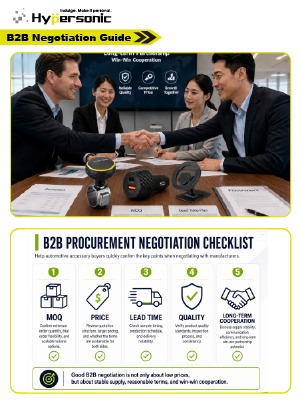
Before contacting car gadget manufacturers, buyers should prepare a clear B2B negotiation checklist. This helps keep the conversation focused and prevents important terms from being missed. However, the checklist should not only cover price. It should also include MOQ, lead time, quality control, packaging, payment terms, exclusive distribution, and future cooperation.
|
Negotiation Area |
Key Questions to Ask |
|
MOQ and pricing |
What is the MOQ? Can we start with a trial order? What affects the unit price? |
|
Lead time |
What is the sample, production, and shipping timeline? |
|
Quality control |
What inspection process is used before shipment? |
|
Packaging |
Can the manufacturer support private label or custom packaging? |
|
Payment terms |
What deposit is required? Can better terms be discussed after repeat orders? |
|
Exclusive distribution |
Is exclusivity available by region, channel, or sales target? |
|
Long-term partnership |
Can we build a reorder plan, forecast system, or product roadmap together? |
In addition, buyers should record every supplier answer in writing. This makes it easier to compare manufacturers and avoid misunderstandings after the order begins.
This section gives buyers a practical checklist they can use before supplier calls or email negotiations. It helps organize the main commercial terms and reduces the chance of missing important details. With a clear checklist, buyers can compare suppliers more fairly, ask stronger questions, and build better negotiation outcomes.
Good B2B negotiation balances buyer goals and manufacturer needs. Buyers need competitive MOQ and pricing, reliable lead time, and enough flexibility to protect cash flow. However, manufacturers also need stable orders, clear specifications, and predictable demand to plan production efficiently.
Therefore, a strong agreement should not focus only on the lowest unit price. MOQ and pricing should support both buyer margins and factory production efficiency. Lead time should also include realistic buffers for samples, packaging, inspection, production, and shipping. In addition, exclusive distribution should be tied to market performance, sales targets, and reorder volume.
Over time, a long-term partnership can create better pricing, faster communication, improved service, and stronger supply stability. Buyers who negotiate with data, respect, and clear business plans usually achieve better results than those who only demand discounts.
Looking for a reliable car gadget manufacturer for your retail, wholesale, or e-commerce business? Contact our team to discuss MOQ, pricing, lead time, customization, and long-term partnership opportunities.
This site uses cookies to improve your browsing experience. we’ll assume you’re OK to continue. If you want to read more about this, please click PRIVACY thank you.